
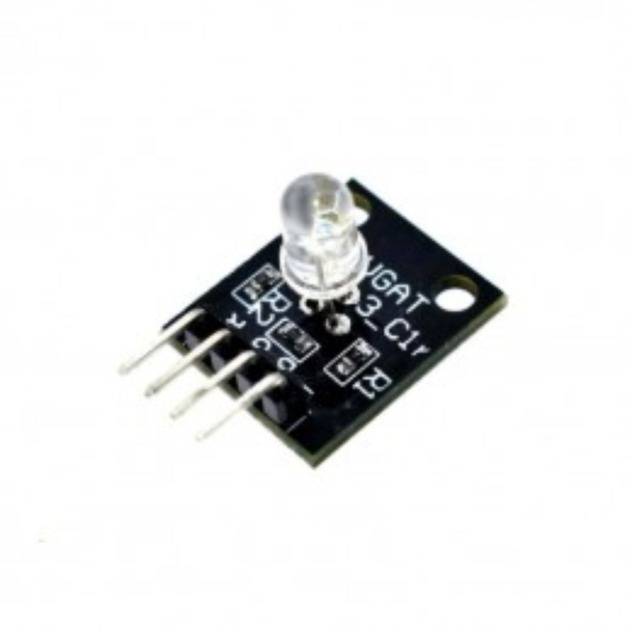
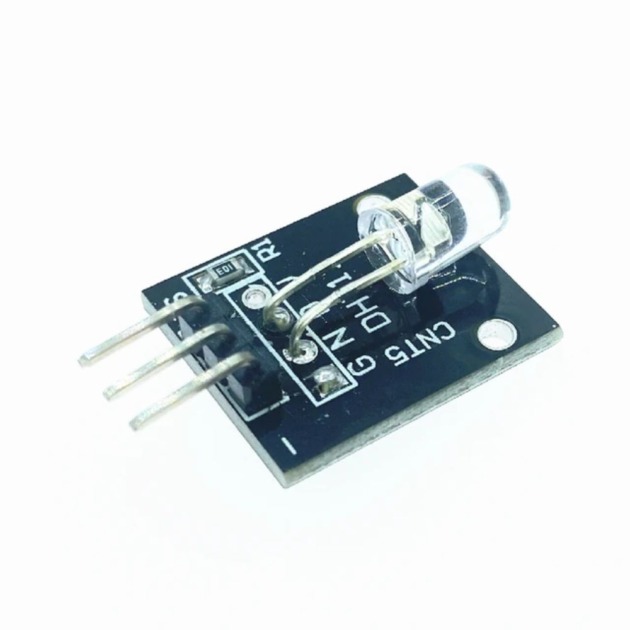
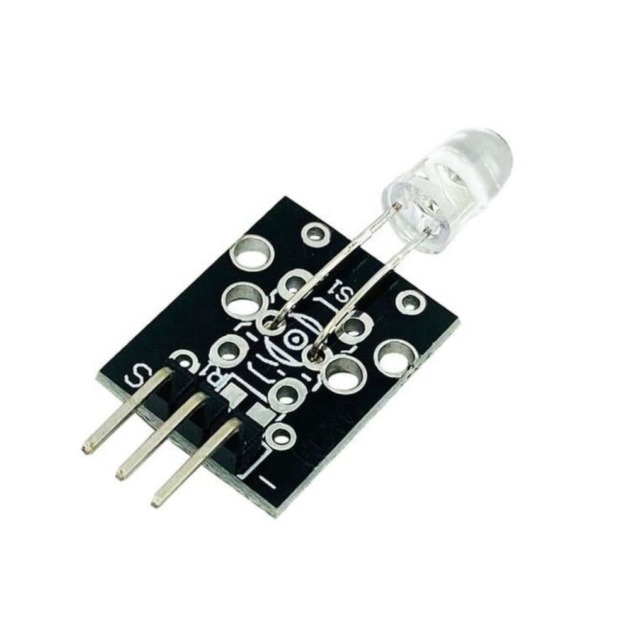
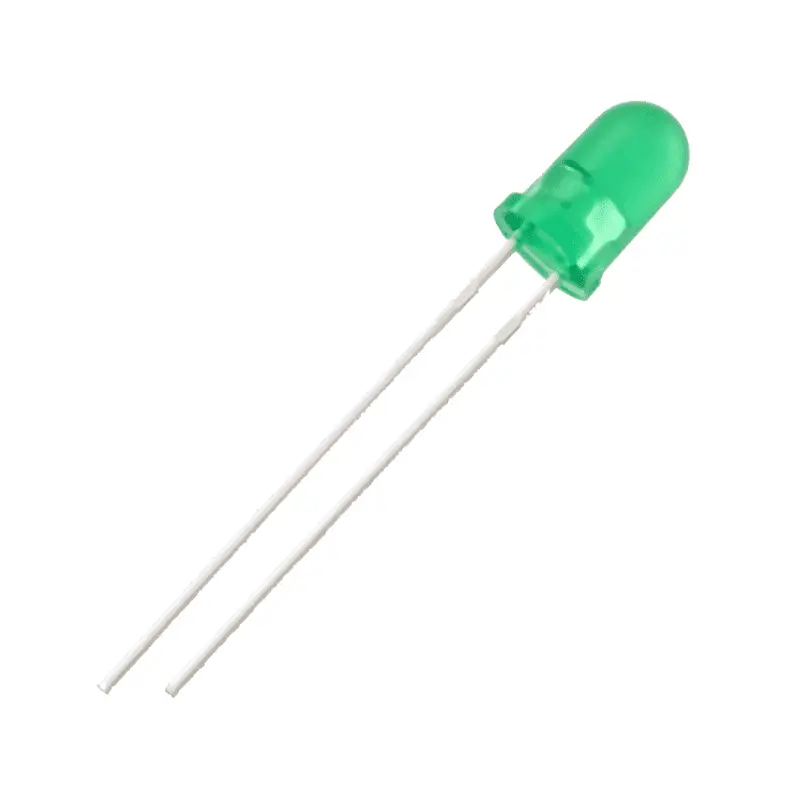
The 3-Color LED Module is a lighting component featuring a single RGB LED—typically 5mm—that emits red, green, and blue light for customizable colour effects. Designed for easy use with microcontrollers like Arduino, it operates at 5V and uses PWM signals to adjust the intensity of each color, enabling a full spectrum from pure primaries to blended shades like yellow or purple. Its four-pin interface (R, G, B, and ground) simplifies connections, making it a favorite for hobbyists and educators.
Enclosed in a clear or diffused lens, the LED delivers brightness around 600-1000mcd for red, 1500-2000mcd for green, and 1000-1500mcd for blue, depending on the model (e.g., KY-016 specs). Mounted on a small PCB (often around 18mm x 15mm), it includes onboard resistors (e.g., 150-330 ohms) to limit current to 20mA per color, though external resistors are recommended for 5V setups to avoid burnout. This module is preferred for applications that need visual feedback.
Key Features:
- Red, green, blue RGB output
- PWM control for color mixing
- Compact 5mm LED on PCB
- Four-pin design for easy wiring
- Bright, adjustable illumination
Technical Specifications:
- Voltage Range: 5V DC
- Input Voltage: 5V (signal via microcontroller)
- Current Consumption: 20mA per color (typical)
- Interface: 4-pin (R, G, B, GND)
- Dimensions: Approx. 18mm x 15mm (PCB size)
- Operating Temperature: -20°C to +60°C
Applications:
- Dynamic lighting in Arduino projects
- Status indicators for DIY electronics
- Color displays in educational kits
- Mood lighting project
- Visual effects in electronic prototypes


Reviews
There are no reviews yet.